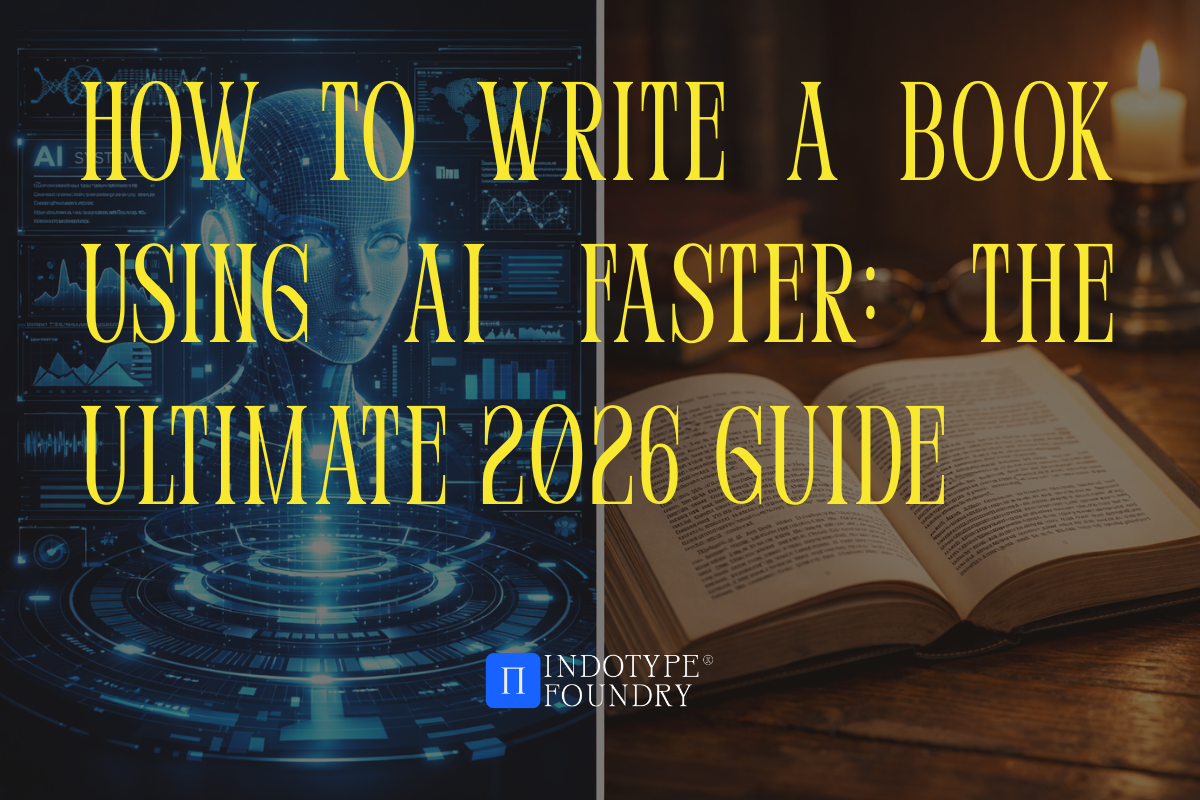
How to Write a Book Using AI Faster: The Ultimate 2026 Guide
Have you ever stared at a blinking cursor for hours, feeling like the story in your head is trapped behind a wall? You’re not alone. In fact, as of early 2026, data suggests that nearly 30% of independent authors are now using generative AI to assist in their creative process. But here is the real kicker: writers using AI aren’t just writing “more”—they are finishing high-quality manuscripts in a fraction of the time it took just two years ago.
Whether you are a graphic designer looking to publish your first design theory book, a marketer aiming for thought leadership, or a novelist ready to break into the digital market, the tools available today have changed the game. Writing a book is no longer a multi-year marathon of solitude; it’s a collaborative sprint with an intelligent partner. But how do you do it without losing your unique “human” voice? And more importantly, how do you ensure the final product looks as professional as it reads?
In this guide, we’ll explore how to write a book using AI smarter and faster, from the initial brain dump to choosing the perfect Indotype fonts that give your words the authority they deserve.
1. The Blueprint: Rapid Outlining and World-Building
The hardest part of writing a book is often the “middle muddle”—that place where your plot loses steam and you realize your structure is crumbling. AI is the ultimate architect for this phase. Instead of starting with Chapter 1, start with a “Prompt Partnership.”
By feeding an AI model your core concept, you can generate ten different narrative arcs in seconds. Want to see how a psychological thriller would look with a nonlinear timeline? Ask the AI. This isn’t about letting the machine decide; it’s about seeing possibilities you might have missed.
Pro Tip: Use the “Recursive Outlining” method. Ask the AI to generate a 12-chapter outline. Then, ask it to break down Chapter 1 into five key beats. Suddenly, you aren’t writing a 60,000-word book; you’re just filling in 500-word segments.
2. Drafting with Flow: Overcoming the Blank Page
We’ve all been there—the dreaded writer’s block. In 2026, “writer’s block” is becoming an optional experience. When you hit a wall, use AI to “rubber duck” your ideas. Describe the scene you’re struggling with and ask the AI to write three different ways the dialogue could end.
A fascinating case study involves Google’s recent updates to its creative suite, where AI tools now help authors maintain tonal consistency across 400-page manuscripts. This ensures that a character’s voice in Chapter 20 matches their introduction in Chapter 1. By using AI as a drafting assistant, you can focus on the “soul” of the story while the AI handles the heavy lifting of descriptive prose or transitions.
“AI doesn’t replace the writer; it replaces the friction between the idea and the page.”
3. Typography: The Secret Sauce of Professional Books
You can write the most life-changing book in the world, but if it’s set in a default, uninspired typeface, readers will subconsciously doubt its value. Typography is the “visual voice” of your book. As a creator, you need to think about the reading experience.
If you are self-publishing, your choice of fonts for AI-written books is critical to establishing credibility. At Indotype, we specialize in typefaces that bridge the gap between digital efficiency and classic elegance.
-
For the Body Text: You need something highly legible that doesn’t fatigue the eye. We recommend Oonelle. It’s a sophisticated serif that brings a traditional “literary” feel to even the most modern AI-assisted manuscripts.
-
For Headlines and Covers: You want something bold and memorable. Check out Behame. It’s clean, authoritative, and perfect for the modern non-fiction author.
-
For Accents: If your book includes “AI-generated” snippets or technical callouts, Horix provides that perfect tech-forward aesthetic.
4. Polishing and Fact-Checking (The Human Touch)
Speed is great, but accuracy is paramount. While AI in 2026 is significantly more advanced than earlier versions, it can still “hallucinate” or provide generic advice. This is where your expertise comes in.
-
Fact-Check Everything: Always verify dates, names, and technical data.
-
Inject Personality: AI tends to be polite and neutral. Add your humor, your sarcasm, and your unique life experiences.
-
The “Read Aloud” Test: Use a text-to-speech tool to listen to your manuscript. If it sounds robotic, it needs more “you” in the edit.
Conclusion
Learning how to write a book using AI is the single greatest productivity hack for creators today. It allows you to move from “aspiring author” to “published author” at a speed that was previously impossible. By leveraging AI for the structure and drafting, and then refining the final product with high-quality Indotype fonts, you create a professional package that stands out in a crowded marketplace.
Remember, the AI provides the clay, but you are the sculptor. Don’t let your ideas stay hidden in your notes app—start building your masterpiece today.
Ready to give your book a professional edge? Grab these premium fonts now at indotype.com and elevate your designs!